2 min read
Designed to help users maintain financials within an existing product ecosystem.
Role
UI, UX, Product
Timeline
August 2025 - October 2025
Skills
Design Thinking
Product Strategy
AI Prototyping
UI Design
This project is under NDA. If you’d like to learn more, feel free to reach out directly.
Overview
This project involved designing a ledger-like financial module for an existing operational product.
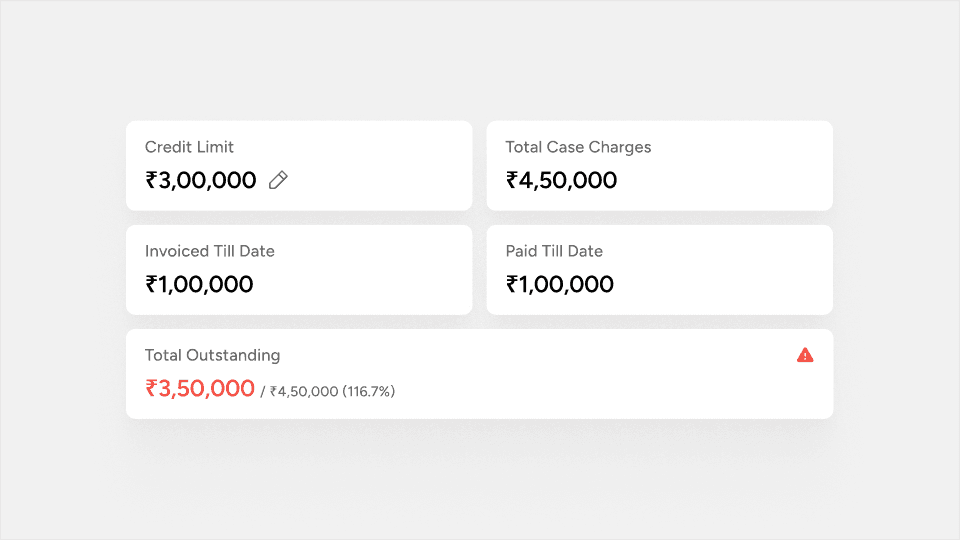
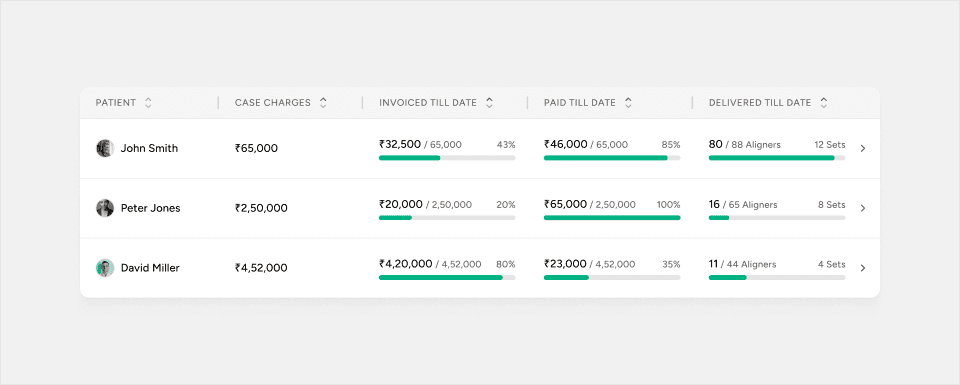
The work focused on structuring financial information, case charges, payments, and invoices into clear, usable flows that support day-to-day operations.
My involvement spanned problem framing, interaction design, and rapid AI-assisted prototyping, working closely with founders and engineering to explore feasible solutions under real-world constraints.
Glimpses of what was made
Problem
No system for vendors and customers to track and manage transactions on the platform.
Vendors had to request payments outside of the portal leading to usage of multiple things for the same item.
Customers had to track and communicate outside of the portal shared by the vendors.
Discovery & Inputs
Through internal discussions and customer-facing insights, a few consistent needs emerged:
Vendors needed a way to define and manage financial limits per customer
Vendors lacked a structured mechanism to raise, track, and follow up on payments
Vendors required a way to request and store proof of payment from customers within the system
Customers needed a single source of truth to track invoices, payments, and outstanding balances
These inputs highlighted gaps in both financial structure and operational visibility, shaping the direction of the ledger module.
Key Design Decisions
Instead of isolated payment screens, the module was designed around a ledger view that shows all financial activity in chronological order.
Charges, payments, and invoices were treated as distinct but connected entities.
Vendors and customers see the same underlying data but through role-appropriate views.
Prototyping & Collaboration
Used rapid AI-assisted prototyping with Lovable, Perplexity and Bolt to explore multiple interaction patterns quickly
Worked closely with engineering to validate feasibility and data constraints
Iterated designs based on what could realistically ship without breaking existing workflows
This allowed faster convergence without over-specifying early.
Other Projects